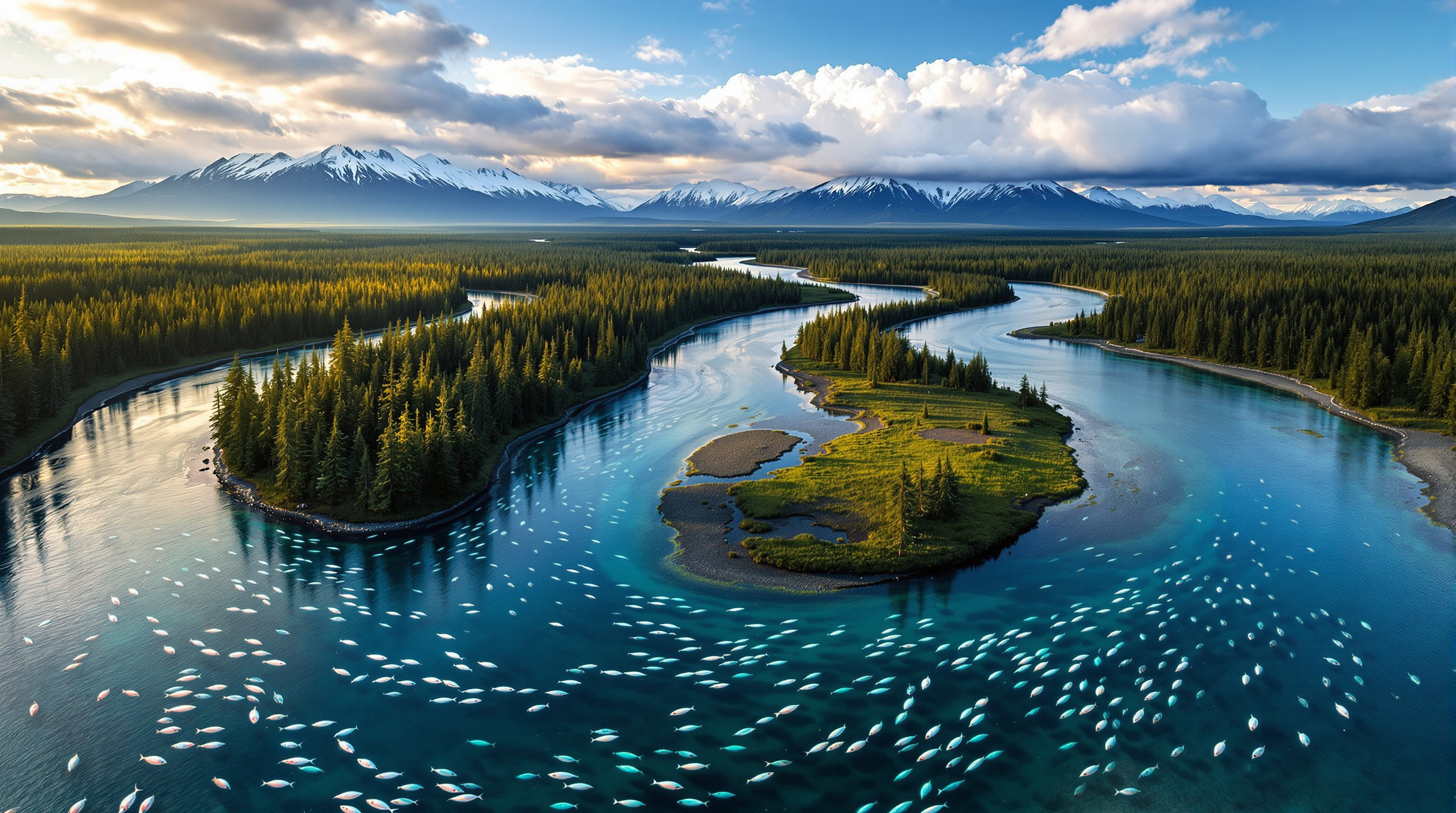
Yukon River Chinook salmon are the subject of a seven-year rebuilding agreement between Alaska and Canada. The agreement sets out a suspension of directed fisheries, provisions for limited ceremonial and cultural harvest, and work toward a recovery plan. It should be read alongside ADF&G's annual run reports: the agreement explains the rebuilding approach, while the reports describe particular seasons and forecasts. Neither a forecast nor the length of the agreement is a promise that a run will recover by a particular date.
The 2024 Alaska-Canada Agreement
On April 1, 2024, the Alaska Department of Fish and Game (ADF&G) and Fisheries and Oceans Canada signed an agreement concerning recovery of Yukon Chinook. Its stated aim is to rebuild stocks so they can again provide subsistence, sport, commercial and personal use fishing opportunities.
The agreement suspends directed Chinook commercial, sport, domestic and personal use fisheries in the mainstem Yukon River and Canadian tributaries for one full life cycle, described as seven years. The species, fishery types and named waters matter when reading that provision. It is a specific rebuilding measure, rather than a statement that every salmon fishery throughout Alaska has the same restrictions.
The agreement also calls for Alaska to minimize incidental Chinook harvest in other mainstem Yukon fisheries during the same period. Directed fishing and incidental harvest are separate issues in the agreement: suspending fisheries that target Chinook does not, by itself, describe every possible encounter with the species.
The 2025 Season
In its April 2026 review and forecast report, ADF&G recorded no commercial fishing in the Yukon Management Area during the summer or fall of 2025. Chinook fishing remained closed all season throughout the Yukon Area. The report nevertheless records a small number of Chinook taken through test fisheries or retained incidentally with nonsalmon gear. A closure should therefore not be paraphrased as proof that no Chinook were taken at all.
The preliminary cumulative passage estimate at Eagle sonar was about 23,863 Chinook. This was the third-lowest season total estimate and did not meet the U.S./Canada border passage objective of 71,000 fish. That is a passage estimate at a named monitoring location, not a commercial harvest figure. Keeping the location and measure attached to the number helps avoid confusing fish counted moving upriver with fish caught.
The 2026 Outlook for Chinook and Fall Chum
ADF&G's final 2026 forecast for Canadian-origin Chinook was 22,000 to 33,000 fish, below the minimum border passage objective of 71,000 fish. Its preliminary drainagewide Chinook forecast was 52,000 to 79,000 fish. The report uses the Canadian-origin forecast to develop the broader outlook, assuming those fish represent approximately 42% of the total run. The two forecast ranges describe different groups and should retain those labels.
ADF&G classified Yukon River Chinook as a stock of management concern under the Policy for the Management of Sustainable Salmon Fisheries. It expected no Yukon Chinook harvest in any fishery during 2026. For fall chum, the drainagewide forecast point estimate was 311,000 fish, below an average run size of 950,000 fish. These statements report the outlook; they do not establish how the 2026 season actually turned out.
Ceremonial Harvest, Traditional Knowledge and the Recovery Plan
The 2024 agreement recognizes Chinook's importance for ceremonial use and the transmission of cultural knowledge. It allows Alaska and Canada, at their discretion, to provide limited harvest opportunities for those purposes during the rebuilding period. This provision does not guarantee an opening or authorize unrestricted harvest. It is a limited, discretionary provision within the agreement.
The agreement also places a priority on traditional and local ecological knowledge research into the health of Yukon Chinook, to better understand low run abundance and identify possible solutions. It directs the Yukon Panel, a group of stakeholders living along the river, to develop a recovery plan. These are the responsibilities described in the agreement; they do not establish that a plan has been completed or that rebuilding has succeeded.
How Endangered Species Status Fits
In May 2026, NOAA Fisheries found Endangered Species Act listing not warranted for three Gulf of Alaska Chinook groups. It assessed all three at low risk of extinction and identified environmental variability as their most significant threat. That finding concerns the groups covered by that review and should be kept separate from the Yukon run forecasts and rebuilding agreement. Conservation measures and annual fishing restrictions still need to be understood on their own terms. The salmon sustainability guide provides broader management context.